Elvis and Me
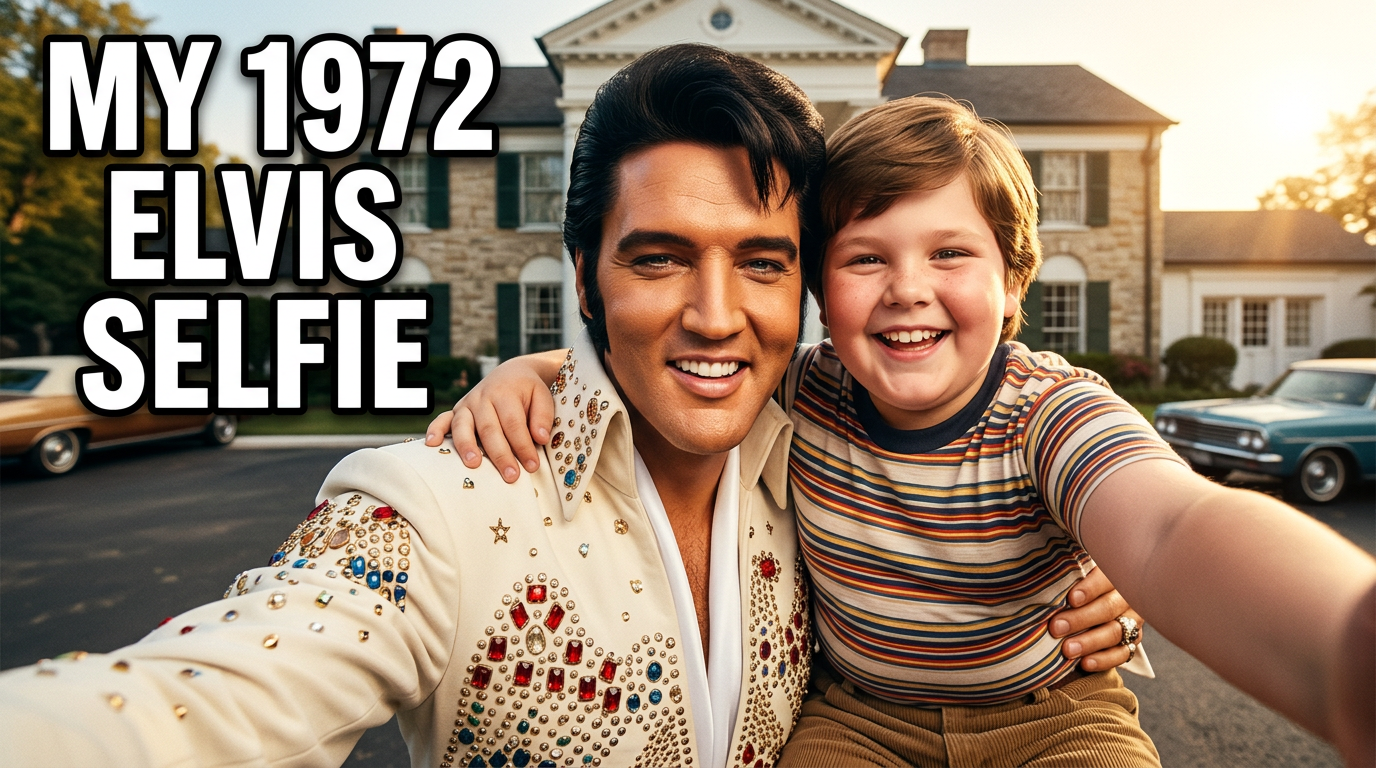
Let me tell you a story. A true story.
First there were no selfies in 1972. I had to use something to get you here.
I was eleven years old. One weeknight I was riding down Highway 51 with my mother and sister in Memphis, Tennessee. We passed Graceland. The gate was open. In Memphis that meant one thing. Elvis Presley was out front receiving fans.
I screamed at my mother to stop. She knew exactly what I wanted. She pulled onto the shoulder and before she had the car in park I was already running.
He was standing on a tree stump just past the gate. He wore a blue chambray shirt with jeans and a belt with a huge buckle — I remember the belt because it was right at my eye level — enormous silver belt buckle with large turquoise stones all over. He looked exactly like he did in the movies. He sounded exactly like he did on television. It was him. It was Elvis.
I was not entirely a stranger to the sight of him. We lived in the same area. I had seen him before — driving past in one of his Cadillacs, riding one of his horses, the way neighbors sometimes see each other without ever meeting. But this was different. This was close.
I wiggled through the crowd from the side. It was mostly women. Young and old. I didn't care about that. I had my pen and my paper and I wanted to meet the man.
And then I waited.
He was in a zone. Hugging the women. Kissing them. Giving them his full attention in a way that made each one feel seen. I was standing literally at his side, holding my pen and paper out, trying to catch his eye. It took thirteen minutes. I know because I was counting in the way that only children count — each minute a small eternity.
He didn't see me. Not because I was hidden. I was right there. He just never looked down.
Finally something made him turn — a sound I made, a movement, I don't know. He looked down at me. Reached down. Took the paper. Signed it. Handed it back. And turned to the next person.
He wasn't mean. He wasn't cruel. I was simply an obligation. A small item on a list. Something to be completed before returning to what actually held his attention.
I went home thrilled. I had the autograph. I had been there.
It wasn't until I was much older — old enough to understand what I had actually been watching — that I realized the truth.
I had stood beside Elvis Presley for thirteen minutes.
And he never saw me.
The Word → γινώσκω
The Greek word is γινώσκω — ginōskō.
It is the word the New Testament uses for knowledge in the deepest sense. Not knowledge about someone. Knowledge of someone. The kind that only comes one way — through time, through presence, through relationship, through conversation. Through actually being with a person.
A husband knows his wife this way. A wife knows her husband. A father knows his child. A friend who has spent years in genuine relationship with another person — they know each other this way.
You cannot ginōskō someone from a distance. You cannot ginōskō someone from a crowd. You cannot ginōskō someone by reading about them, watching them, or standing beside them for thirteen minutes while they look the other way.
The Greek New Testament has another word for that kind of knowledge — oida. Facts. Information. Awareness. You can oida someone you have never met.
But ginōskō requires something oida never does.
It requires the other person to know you back.
Elvis Presley did not ginōskō me. And I did not ginōskō him.
I would not understand why that mattered — truly mattered — until I read these words from Jesus Christ himself.
"Not everyone who says to Me, 'Lord, Lord,' will enter the kingdom of heaven, but the one who does the will of My Father who is in heaven. On that day many will say to Me, 'Lord, Lord, did we not prophesy in Your name, and cast out demons in Your name, and do many mighty works in Your name?' And then will I declare to them, 'I never knew you; depart from Me, you workers of lawlessness.'"
— Matthew 7:21–23
I Never Knew You
That word — knew — is ginōskō.
Not: I never heard of you. Not: you never showed up. Not: your works were insufficient.
I never knew you.
These were not casual people. They prophesied. They cast out demons. They did mighty works — in His name. By any external measure they were serious, devoted, active followers of Jesus Christ.
And He did not know them.
Close Without Arriving → Proximity
I am not the only one who has stood close without arriving.
Judas was in the inner circle for three years. He never arrived.
Philip walked beside Jesus for three years and one day said — Lord, show us the Father. Jesus answered with something that sounds like grief: "Have I been with you so long and you still do not know me?"
Proximity is not ginōskō. Activity is not ginōskō. Even years of sincere following is not ginōskō — until it is.
What Was Missing → What Elvis Missed
There is something I never considered as a boy.
While I stood beside Elvis Presley — pen out, waiting, invisible — what was he missing?
Not an autograph request. A child. A real person, standing right there, who wanted nothing from him except to be seen.
He never looked down. And so he never knew what was beside him.
I wonder sometimes how many years I stood beside Jesus Christ exactly the way Elvis stood beside me. In the zone. Busy with good things. Going to church and genuinely enjoying the presence of people who called His name. Checking every box. Feeling the feeling. Going through the motions of a man who belonged there.
While He waited.
Not angry. Not withdrawing. Just — there. Holding out something I kept being too busy to receive.
Here is what I know now that I did not know then.
The Offer
Jesus Christ is the eternal Son of the Most High God — the One through whom all things were made, in whom all things hold together, before whom every knee in heaven and earth will one day bow. He walked out of eternity into human flesh, suffered the weight of every sin ever committed, descended into death, and rose bodily from the grave.
And this Person — this One — wants to know you.
Not know about you. Know you. By name. From the inside. The way only He can.
That is not a system. That is not a belief to be maintained. That is the most staggering offer ever extended to a human being.
He is not looking for your activity. He is not looking for your service, your attendance, or your theology.
He is looking for you.
The actual you. Turned toward Him. Present. Still enough to be known.
This is what it means to walk with Jesus Christ — not to perform for Him, not to work on His behalf from a comfortable distance, but to know Him. To be known by Him. To have that mutual, living, personal knowledge that changes everything it touches — the kind the New Testament calls ginōskō.
He wants that with you.
He has always wanted that with you.
And He is still waiting — the way that boy waited — for you to turn and look at Him.
Is Jesus Christ a person to you — or an idea?
That's the question only you can answer. But it is the only question that finally matters.